NASA and CNES Release Unprecedented Global River Discharge and Water Quality Estimates
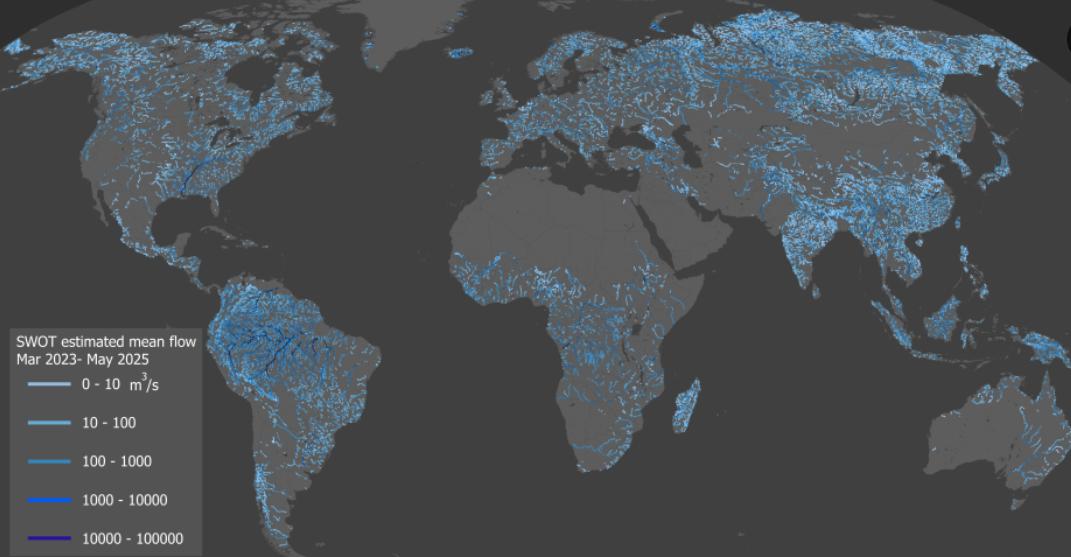
fig.1 This data visualization shows the mean flow of global rivers for March 2023 to May 2025, as seen by the Surface Water and Ocean Topography (SWOT) platform (m3/s). Darker blues indicates larger water flow estimates, while lighter blues reflect smaller river flow estimates. Credit: Colin Gleason
Since December 2022, the Surface Water and Ocean Topography (SWOT) platform has provided valuable data and information about the world's oceans and its terrestrial surface water. On land, SWOT captures observations of water storage changes (such as surface water area and water depth) of major lakes, reservoirs, rivers, and wetlands, and supports derived estimates of river discharge, which aid in assessing water resources.
SWOT estimates discharge by using the cloud-based, open-source Confluence computational framework, which was developed by members of the SWOT Discharge Algorithm Working Group and supported by a grant from NASA's Earth Science Technology Office (ESTO). It merges outputs from six science algorithms developed over decades with in-situ measurements and observations from both SWOT and Harmonized Landsat and Sentinel-2 (HLS) to estimate river discharge and suspended sediment at the same time and at a global scale.
A result of collaboration between NASA and CNES (the French national space agency) science teams, the SWOT Level 4 Sword of Science River Discharge Products, Version 3 are archived and made available through NASA's Physical Oceanography Distributed Active Archive Center (PO.DAAC). These data are also available in NASA Earthdata Search.
The SWOT Level 4 Sword of Science River Discharge Products, Version 3, provide discharge time series for the six flow law parameter estimate (FLPE) algorithms and a single ‘consensus’ estimate that represents the canonical ‘SWOT Discharge.’
The discharge product is organized by continent following SWOT River Database (SWORD) structure and naming conventions. It is indexed on the same reach and node identifier dimensions found in SWORD. Time series data is stored by cycle and pass on an observation dimension. Outputs from Confluence are organized into groups corresponding to modules in the SWOT-Confluence processing software. Modules are described in the Confluence Module Documentation.
These L4 discharge and water quality time series are available as netCDF, and released with an estimate of discharge matching each quality-controlled SWOT observation. The temporal frequency of discharge estimates is different for each river.
The River Discharge from the SWOT Mission video provides an overview to help users better understand the discharge product. Please note that the discharge products associated with this release, referred to in the video as L4 Product Science Team Discharge data products, now meet mission requirements. To learn more about the contents and structure of the data product, refer to the SWOT HR River Discharge Products v1.0 Quick Guide and the Graphical Overview.
For a practical introduction to the data product and access, explore this collection of SWOT Discharge videos. Additional data tutorials and resources are forthcoming. Users can refer to the PO.DAAC Cookbook - SWOT Chapter for the latest content.
Related press releases include NASA Science’s NASA-French SWOT Satellite Provides Global Estimate of River Discharge and University of Massachusetts Amherst’s Unprecedented Data on Global River Quality, Quantity Now Gathered From Space, Powered by UMass Amherst-Built Software.
About Confluence
The Confluence framework leverages the cloud, with the algorithms being co-located with SWOT data in the PO.DAAC archive hosted in the Amazon Web Services (AWS) cloud. It also uses the PO.DAAC SWOT time series data service, the Hydrocron API. Both are making processing of the data more efficient than traditional data workflows, especially when working with large observational datasets such as those from the SWOT mission. More information is available in the SWOT-Confluence Github repository Documentation section.
来源:NASA Earthdata
NASA and CNES Release Unprecedented Global River Discharge and Water Quality Estimates | NASA Earthdata